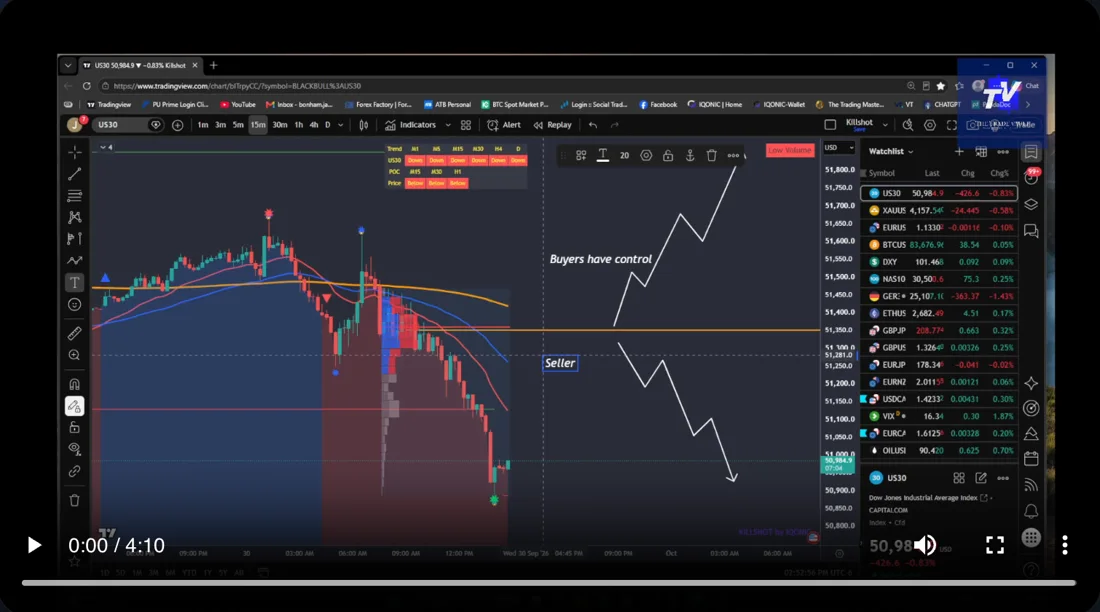
- The US cash session opens at 9:30 AM ET; US economic news often lands at 8:30 AM ET.
- Mark your levels before the open: previous day high and low, overnight high and low, and the Point of Control.
- The first minutes are the most volatile. Waiting for a candle close beats chasing the first move.
- Size the trade from your stop, not from how confident you feel.
What is the New York open?
US30 is the Dow Jones Industrial Average, an index of 30 large US companies. As a CFD or future it trades almost around the clock, but its underlying stocks only trade during the US cash session, which opens at 9:30 AM Eastern Time.
That’s the New York open. Orders that built up overnight hit the market at once, institutions start working their positions and volume jumps. For most of the year 9:30 AM ET is 2:30 PM in London. For a couple of weeks in March and November, when the US and UK clocks change on different dates, it’s 1:30 PM.
The times that matter
| Time (ET) | What happens |
|---|---|
| 8:30 AM | Major US data often releases here (CPI, jobs reports, jobless claims). Price can jump before the open. |
| 9:00 AM | Final prep: levels marked, plan written, risk decided. |
| 9:30 AM | US cash open. Highest volume and widest swings of the morning. |
| 9:30–10:30 AM | The opening hour, where the day’s first real move usually sets up. |
| 10:00 AM | Another common time for US data releases. |
Always check the economic calendar the night before. A big release at 8:30 or 10:00 can turn a clean setup into a coin flip.
How to prepare before 9:30
The open rewards people who did their work earlier. Before the bell, mark these on your chart:
- Previous day high and low. Price often reacts at yesterday’s extremes.
- Overnight high and low. The range built in the Asian and London sessions.
- The Point of Control. Where the most volume traded. See our guide to the POC.
- The trend on your higher timeframes. Decide whether you’re looking for buys, sells or nothing.
Then write one sentence: “If price does X at level Y, I’ll take a trade with my stop at Z.” If that doesn’t happen, you don’t trade.
A rules-based way to trade it
The open is where impulsive traders lose the most, because everything moves fast and every candle looks like an opportunity. A simple rule set keeps you out of the noise:
- Trend first. Only trade in the direction of your higher-timeframe trend.
- Location second. Only take trades at a level you marked before the open, ideally a pullback into the POC.
- Wait for the close. Let the candle close before you act. The first spike is often a fake-out.
- Stop and size before entry. Know your stop and work out your position size from it.
- Know your target. Plan a risk-to-reward of at least 1:2 so one winner pays for two losers.
Watch it done live
Jay Bonham trades the US30 New York open live in The Trade Vault on Tuesday, Wednesday and Thursday mornings, using the Killshot scanner: levels marked before the bell, no trade without a candle close, stop and size set first.
Frequently asked questions
What time is the New York open?
The US stock market opens at 9:30 AM Eastern Time. That’s usually 2:30 PM in London (1:30 PM for a couple of weeks in March and November) and 6:30 AM Pacific.
Why is US30 so volatile at the open?
Orders that built up overnight execute at once and institutions start working positions, so volume and price swings are at their highest in the first hour.
Should beginners trade the New York open?
Only with a written plan, a small fixed risk and the patience to wait for a candle close. Watching it on a demo account for a few weeks first is a good idea.
Is the New York open the same as the London open?
No. The London session opens at 8:00 AM UK time (3:00 AM ET). The New York open is later, and the overlap of the two sessions is often the most active part of the day.