- The POC is the price with the highest traded volume in a session or range.
- Price often returns to the POC, so it works as a magnet, a support or resistance level, and a target.
- The cleanest trades use the POC as location: wait for price to pull back to it in the direction of the trend.
- A POC on its own is not a signal. Combine it with trend and a trigger.
The Point of Control, explained
Most charts show you price and time. A volume profile adds a third thing: how much volume traded at each price. Turn it on and you get a sideways histogram next to your candles. The longest bar on that histogram is the Point of Control.
In plain terms, the POC is the price the market spent the most effort on. More contracts changed hands there than anywhere else in the range you’re measuring, whether that’s a single session, a day, a week or a custom range.
Around the POC sits the value area, usually the band of prices where about 70% of the volume traded. The top and bottom of it are called the value area high and value area low. Together they tell you where the market considers price “fair”.
Why price reacts to the POC
The POC matters because of who traded there. A price with heavy volume means lots of positions were opened at that level. When price returns to it later, those traders are back at their entry price, and many of them act: adding, defending or closing positions.
That’s why you’ll often see three behaviours around a POC:
- Magnet: when price drifts away from value, it often gets pulled back toward the POC.
- Support or resistance: in a trend, a pullback into the POC often holds and the trend continues.
- Acceptance: if price pushes through the POC and holds the other side, value is shifting, which is information in itself.
None of these is guaranteed. The POC gives you a reason for price to react, not a promise that it will.
How to use the POC in your trading
The most useful way to think about the POC is as location. It answers “where should I be looking to get in?” It doesn’t answer “which way?” or “when?”. That’s why at The Trade Vault it’s one of three rules, not a strategy on its own:
- Trend: decide the direction first. If the higher timeframes are bullish, you’re only looking for buys.
- Location: wait for price to pull back into the Point of Control.
- Trigger: only enter when your signal confirms, with the stop and target set before you click.
A pullback to the POC in the direction of the trend gives you a defined level to lean on. Your stop goes beyond it, so if the level fails you’re out with a small, known loss.
The POC also makes a sensible target. If you’re in a trade that started away from value, the POC is a natural place to take some or all of the profit.
Common POC mistakes
- Trading every touch. Price touches the POC constantly in a range. Without the trend and a trigger, you’re just guessing more often.
- Ignoring the timeframe. A POC from a single 3-minute leg is weaker than the session POC. Know which one you’re looking at.
- Fighting the trend. Selling a POC in a strong uptrend because “it’s resistance” is one of the most expensive habits in trading.
- No stop. Levels break. Decide where you’re wrong before you enter.
How Killshot uses the POC
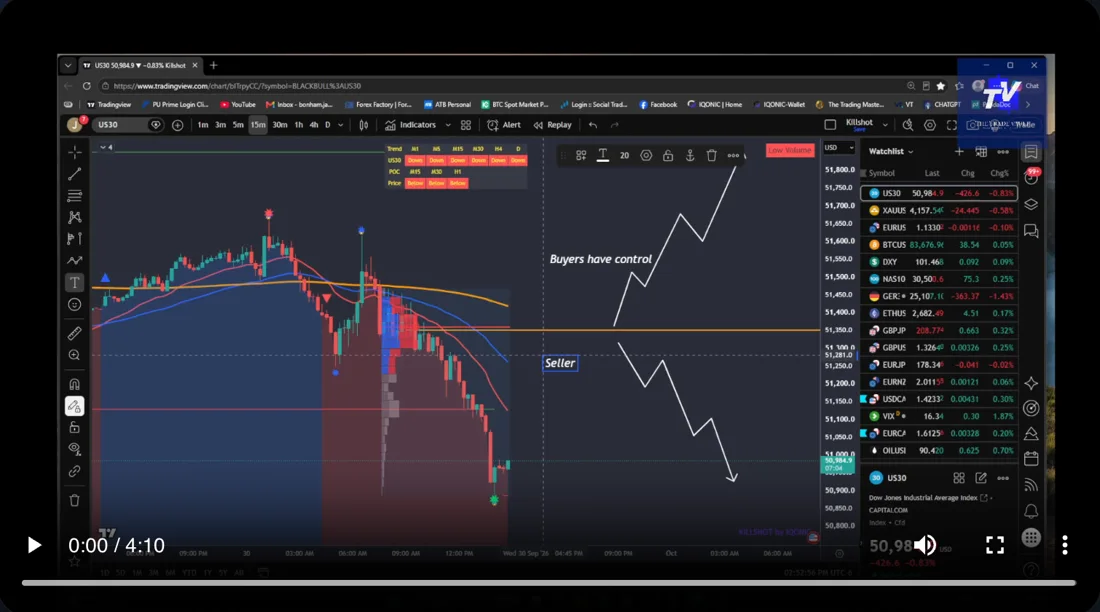
The Killshot scanner plots the Point of Control on the chart alongside its EMA trend read and signal stars, so you can see all three rules at once. Lesson 4 of the Killshot Bootcamp, “What is the POC?”, walks through it on live charts.
Frequently asked questions
Is the Point of Control support or resistance?
It can act as either. In an uptrend a pullback to the POC often holds as support; in a downtrend it often acts as resistance. If price accepts on the other side of it, value is shifting.
What’s the difference between the POC and the value area?
The POC is the single price with the most volume. The value area is the band around it where roughly 70% of the volume traded, bounded by the value area high and low.
Which timeframe should I use for the POC?
Use the session or daily POC for your main levels. Shorter ranges give you more levels but weaker ones.
Does the POC work on forex, gold and indices?
Yes. The idea is the same on any market with volume data. On spot forex and CFDs the volume is your broker’s tick volume, which still shows where activity concentrated.